Cold Hands, Warm Mugs: A Potter’s Field Guide to the 2026 Christmas Market Season
It’s 7.15am on a Saturday in early December and you are standing in a church hall somewhere in the Midlands, trying to work out whether the trestle table in front of you is level. The car smells of packing paper and cold coffee. Somewhere in the boot, wrapped in a towel, is a box of mugs you spent three weeks glazing. This is the 2026 Christmas market season, and nobody warned you that the hardest part would be the logistics.
Taking pottery to a UK Christmas fair is a strange hybrid of retail, performance and endurance sport. The stalls that look effortless on Instagram are usually the result of a dozen small decisions made before the doors open. Here is what experienced makers tend to mention only after their second mulled wine.
The table is the cheapest part
Stall fees vary wildly, from a few pounds for a school hall to several hundred for a city-centre pitch. It is tempting to pick the cheapest option, but the better question is who else will be there. A fair with no other ceramicists can be a gift. A fair with six potters selling similar mugs is a price war nobody wins. Ask the organiser how many ceramics stalls are booked, what the footfall was like last year, and whether visitors tend to buy or browse.
Position matters more than you think. A corner plot gives you two sides to display and a bit of breathing room. A spot beside the mulled wine queue means people will stand near your table for ten minutes, which is not the same as looking at your work. A spot beside the door is lovely in July and brutal in December. If you can, visit the venue beforehand or ask for a floor plan.
Build a stall that survives a draft
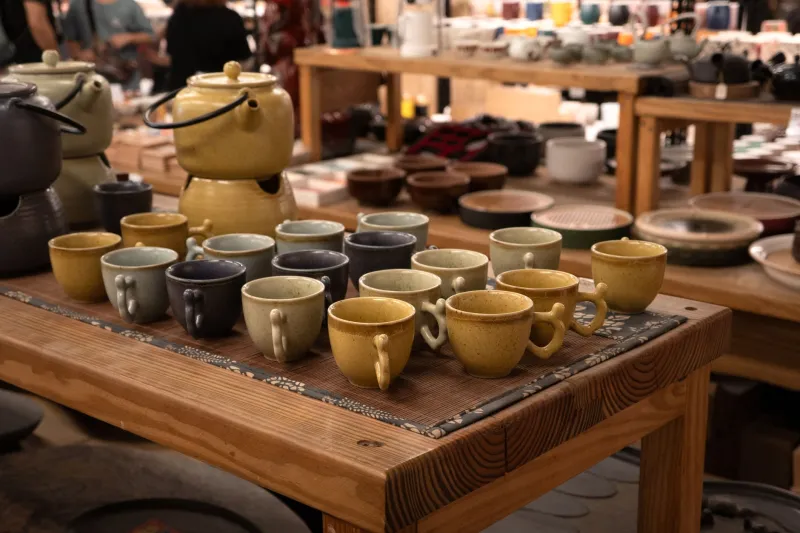
Display is where first-timers tend to overdo it. Too many pots on one table reads as clutter, and clutter makes people nervous about picking anything up. Use levels — crates, boxes covered with linen, a couple of sturdy plinths — so taller pieces sit at the back and smaller pieces come forward. Leave gaps. A mug with space around it looks like a considered object rather than stock.
Price everything clearly. Little handwritten tags are charming, but they need to be readable from standing height. If someone has to ask the price of three things, they will usually put the third one down and walk away.
Outdoor pitches need weights, not optimism. A gazebo with four legs and no ballast is a kite with a pottery habit. Bring at least 12–15kg per leg, side panels if rain is forecast, and something to raise stock off the ground. Indoor stalls have their own hazards: condensation on cold pots, drafts from fire doors, and a distinct shortage of sockets. Battery fairy lights are your friend. If you are using mains equipment, check the venue’s PAT testing requirements before you turn up.
Pricing without the flinch
Christmas shoppers are not a separate species with a different budget. They are the same people who buy your work in June, except they are buying gifts and they are tired. Do not drop your prices because the tinsel is up. Work out your cost per piece — clay, glaze, firing, packaging, card fees, stall fee, your time — and price from there.
A common mistake is bringing only large, expensive pieces because they photograph well. Bring a range: a few £15–£22 gift-friendly pieces, a solid middle, and one or two statement pots that remind people what you can really do. A clearly labelled seconds basket is fine, as long as the flaws are honest and the prices are not insulting. What you should avoid is the slow drift into discounting handmade work to compete with a factory mug in a supermarket. It is a race you cannot win, and it teaches customers to wait for January.
The card reader and the cash float
Assume the signal will be terrible. Church halls, village halls and marquees are basically Faraday cages with tea urns. Take a card reader that supports offline mode, a charged power bank, and a backup payment method. A cash float of around £50 in mixed coins and fivers covers the person who wants to pay for a £9 trinket with a twenty. Put a small, clear sign at eye level: ‘Card and cash welcome.’
Keep a simple record of sales as you go. A notebook with a running total is enough, but it makes the post-market admin far less miserable. If you are registered for self-assessment, those card fees and stall fees are business costs, and the receipts add up.
Wrapping is part of the product
A pot that is handed over in a thin carrier bag feels cheaper than the same pot wrapped in tissue and a paper bag with a handle. You do not need to go full luxury hamper. A sticker with your name, a care card, and a sheet of recycled tissue is enough. Offer to hold purchases behind the stall so people can keep shopping without carrying a heavy bag. Keep a couple of cardboard boxes for larger pieces, and a roll of bubble wrap for the inevitable last-minute buyer who is getting the train home.
Reading the room
Stand, don’t hover. A maker who pounces on every person who slows down is exhausting to shop near. A maker who is deep in a phone is invisible. Aim for the middle: make eye contact, say hello, and let people pick things up. Have one piece you genuinely enjoy talking about — a glaze that came out unexpectedly, a handle that took three attempts — because a real story is more persuasive than a sales pitch.
Watch what people touch. The mug that gets picked up and turned over five times is the one to make more of next year. The bowl that everyone admires and nobody lifts might be priced too high for the audience, or it might just need a better position on the table.
The honest bit about energy
A Christmas market is a long day. Twelve hours on your feet, smiling, making small talk, and doing mental arithmetic is genuinely tiring. Bring water, snacks that are not mince pies, and a friend if you can. Take a lunch break even if the hall feels busy. Do not panic-sell at 3pm because the footfall has dropped. Pack down slowly, label your boxes, and write down what sold and what did not while it is still fresh.
Your first fair is a paid rehearsal. The 2026 season will teach you more than any planning checklist. Book early for next year, ask the awkward questions, and remember that the potters who look like they have it all figured out are usually just on their fourth thermos.